






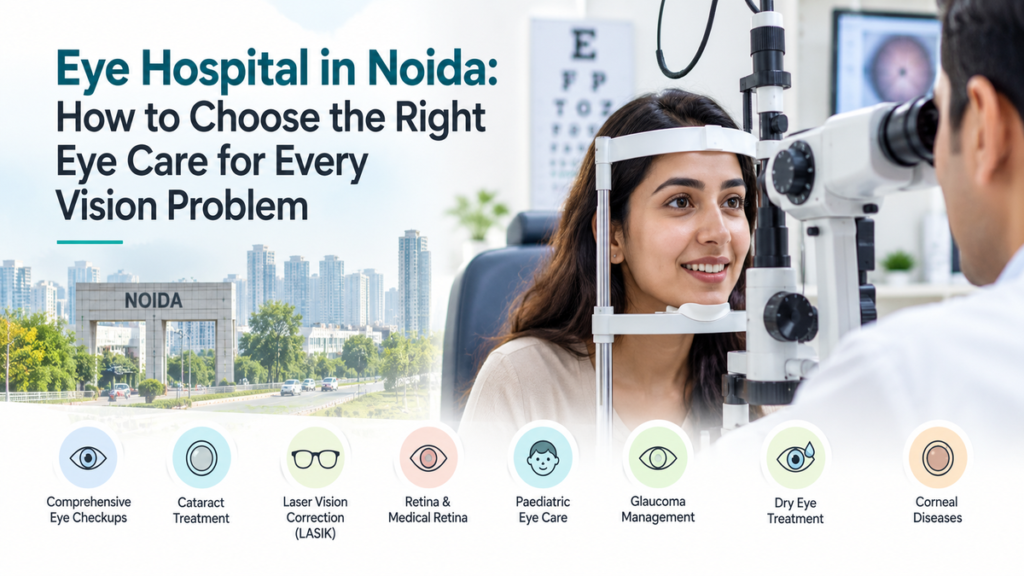
Good eye care is not only about finding a hospital when your vision becomes blurry. The right eye hospital should be able to evaluate the problem accurately, connect you with the appropriate ophthalmology specialist, perform the required diagnostic tests, explain treatment options clearly, and provide follow-up care when needed.
What Makes a Good Eye Hospital in Noida?
Searching for an “eye hospital in Noida” is usually the first step, but the search should not end with location alone.
Eye conditions can involve very different structures of the eye. Cataract affects the natural lens, glaucoma affects the optic nerve and is commonly associated with increased eye pressure, retinal diseases affect the light-sensitive tissue at the back of the eye, while corneal disorders involve the transparent front surface of the eye.
A comprehensive eye hospital should therefore provide access to different ophthalmology subspecialties rather than treating every problem through the same general pathway.
Start With the Right Eye Examination
One of the most important things patients should consider when choosing an eye hospital is the quality and scope of the examination.
A routine eye check may include vision assessment and refraction, but depending on symptoms and medical history, an ophthalmologist may recommend additional examinations or diagnostic imaging.
The purpose is not simply to identify whether someone needs glasses. A detailed examination can help detect eye diseases at an earlier stage and determine whether further evaluation is necessary.
Choosing the Right Specialist for Your Eye Problem
A major advantage of a comprehensive eye hospital is access to multiple ophthalmology specialists.
Cataract and Refractive Services
Cataract occurs when the natural lens of the eye becomes cloudy and can cause blurred vision, glare and difficulty performing everyday activities. Patients with cataract may require an assessment to determine whether surgery is appropriate and which intraocular lens option may suit their visual requirements.
Glaucoma Care
Glaucoma is often called a silent eye disease because significant damage can develop without obvious symptoms in its early stages. People with a family history of glaucoma, raised eye pressure, suspicious optic nerve findings or other risk factors may need regular monitoring.
Retina and Vitreoretinal Care
The retina plays a critical role in vision. Conditions affecting the retina can sometimes progress without early warning symptoms. Patients may require retinal evaluation when they experience sudden flashes, new floaters, distorted vision, changes in central vision or other unexplained visual disturbances.
Cornea and External Eye Conditions
The cornea is the transparent front surface of the eye and plays an important role in focusing light. Corneal conditions can cause blurred vision, discomfort, sensitivity to light, irregular vision or other symptoms.
Pediatric Ophthalmology and Squint
Children should not always be evaluated in exactly the same way as adults. Problems such as squint, lazy eye, childhood refractive errors and other vision-development issues may require specialised assessment.
Oculoplasty and Neuro-Ophthalmology
Some eye problems involve structures around the eye, eyelids and orbit, while others may involve the relationship between the visual system and the nervous system. These cases may require specialised ophthalmology assessment rather than a routine vision check.
When Should You Consider a LASIK or Refractive Surgery Consultation?
Many people searching for an eye hospital in Noida are actually looking for a solution to reduce dependence on spectacles or contact lenses.
LASIK and other refractive procedures can correct certain refractive errors, but not everyone is automatically suitable for laser vision correction. The procedure should be selected after an appropriate eye evaluation.
Factors such as refractive power, corneal shape and thickness, ocular health, age, tear-film status and other clinical findings can influence whether a particular procedure is appropriate.
ICARE’s website describes LASIK services including Femto laser, robotic, bladeless and I-LASIK technologies, and its refractive information discusses options such as SILK, Femto LASIK, PRK and ICL.
Why Diagnostic Technology Matters in Modern Eye Care
Technology should not be considered separately from clinical expertise. A diagnostic device is useful because it helps the ophthalmologist understand the patient’s eye more precisely.
ICARE lists technologies and diagnostic systems including Orbscan, Pentacam imaging, OCT imaging systems, Humphrey perimeters, visual electrophysiology and specular microscopy.
For a patient, the important question is not simply which hospital has the latest machine, but whether the diagnostic information will help the ophthalmologist make the right clinical decision.
What to Expect During an Eye Hospital Visit in Noida
The exact process varies depending on the complaint, but a typical ophthalmology consultation may include understanding your symptoms, vision assessment, a detailed eye examination, additional diagnostic tests when required, treatment discussion and follow-up.
Previous prescriptions, reports, scans, medication information and details of previous eye surgeries can be useful to bring to an appointment.
Eye Hospital in Noida for Emergency Eye Problems
Not every eye problem should wait for a routine appointment.
A sudden change in vision, eye injury, chemical exposure, severe eye pain or sudden flashes and floaters can require urgent medical assessment. Patients should seek appropriate emergency eye care rather than relying on online advice when vision changes suddenly or a serious injury occurs.
ICARE lists emergency eye care among its services and states that it provides 24×7 emergency services.
How Location Can Matter When Choosing an Eye Hospital
Noida is connected to a large Delhi NCR population, and patients may travel from nearby parts of Delhi, Greater Noida and surrounding areas for specialised eye care.
However, location should be considered together with the type of care required. For a routine spectacle check, proximity may be the main consideration. For cataract, glaucoma, retinal disease, corneal disease or refractive surgery, access to the appropriate specialist and diagnostic facilities may be more important.
ICARE’s primary centre is located at E3A, Sector 26, Noida, Uttar Pradesh 201301. The hospital also lists a Greater Noida West centre at Sector 04, Gaur City-1.
Why a Multispecialty Eye Hospital Can Be Useful
A patient’s eye problem does not always fit neatly into one category. A patient may visit for reduced vision and initially assume that the problem is simply a change in spectacle power. Examination may reveal cataract, retinal changes, glaucoma or another condition.
A tertiary eye-care environment can make it easier to move from initial examination to specialised evaluation when required.
What Patients Should Ask Before Choosing an Eye Hospital
Before booking an appointment, patients can ask which specialist they should see, whether diagnostic tests may be required, whether surgery is the only option, what records they should bring, and whether follow-up visits will be needed.
These questions can help patients make a more informed decision rather than selecting an eye hospital based only on online ratings or distance.
ICARE Eye Hospital in Noida
ICARE Eye Hospital & Post Graduate Institute is located in Sector 26, Noida and has been providing ophthalmic care since 1993. The hospital’s official website describes comprehensive ophthalmic services and lists multiple subspecialties and clinical services, including cataract, LASIK, glaucoma, cornea, vitreoretina and uvea, pediatric ophthalmology and squint, oculoplasty, neuro-ophthalmology and emergency eye care.
Frequently Asked Questions
1. Which eye hospital should I choose in Noida?
The right eye hospital depends on the type of problem you have. Look for access to qualified ophthalmologists, appropriate diagnostic facilities, relevant subspecialties and follow-up care.
2. When should I visit an eye hospital instead of an optical shop?
Symptoms such as persistent blurred vision, eye pain, flashes, floaters, double vision or unexplained visual changes require evaluation by an ophthalmologist.
3. Does every blurred-vision problem require new spectacles?
No. Blurred vision can have several causes, including refractive errors, cataract, corneal conditions, retinal disease and other eye problems.
4. Which specialist should I see for glaucoma?
Patients with suspected or diagnosed glaucoma generally require assessment by an ophthalmologist with glaucoma expertise. Evaluation may include eye-pressure measurement, optic nerve assessment and visual field testing.
5. Can children receive specialised eye care in Noida?
Yes. Children may require specialised assessment for refractive errors, squint, amblyopia and other vision-development problems.
6. Is LASIK suitable for everyone?
No. LASIK and other refractive procedures require an individual assessment. Corneal characteristics, refractive error, ocular health and other factors influence suitability.
7. What is the difference between LASIK and ICL?
LASIK reshapes the cornea using laser technology, while ICL involves placing an implantable lens inside the eye. The appropriate option depends on individual clinical factors.
8. When is an eye problem considered an emergency?
Sudden loss or major change in vision, serious eye trauma, chemical exposure, severe eye pain and some sudden retinal symptoms require urgent medical assessment.
9. Does an eye hospital need advanced diagnostic technology?
Advanced diagnostic equipment can be valuable when clinically appropriate. The important factor is how the ophthalmologist uses examination findings and diagnostic information.
10. How can I book an appointment at ICARE Eye Hospital in Noida?
ICARE lists appointment facilities for its Sector 26 Noida centre. The official contact page provides appointment phone numbers, hospital addresses and an appointment form.
Book an Eye Consultation at ICARE Eye Hospital, Noida
If you are experiencing a change in vision, have been advised to see an ophthalmologist, or want a specialist opinion for an existing eye condition, an appropriate eye examination is the best starting point.
ICARE Eye Hospital & Post Graduate Institute is located at E3A, Sector 26, Noida, Uttar Pradesh 201301. The official website lists +91-120-3586666/600/601/602 for the Sector 26 centre and +91-9811880015 for appointments.
Conclusion
Choosing an eye hospital in Noida should involve more than comparing distance or searching for a hospital with a particular procedure.
The right choice depends on the patient’s actual eye problem, the specialist required, the quality of examination, appropriate diagnostic support, treatment options and continuity of care.
From routine vision concerns to cataract, glaucoma, retinal disease, corneal conditions, childhood eye problems and refractive surgery, a comprehensive ophthalmology centre can provide a more structured pathway for diagnosis and treatment.
For anyone searching for an eye hospital in Noida, the most important first step is simple: get the right eye problem identified before deciding on the treatment.
ICARE Eye Hospital, Sector 26 Noida: https://www.icarehospital.org/sector-26-noida/
ICARE Eye Hospital LASIK and refractive services: https://www.icarehospital.org/category/lasik-surgery/
ICARE Eye Hospital Contact and Appointment Information: https://www.icarehospital.org/contact-us/